This is my art—pretty much everything over the past 25 or so years. I’m a completist; I like to keep a record of all of it. I’m a flawed human being, I make some good art and some bad art, but all of it together is who I am.
You’ll find various thematic categories you can browse through in the menus above.
My work exists within the gift economy, not the consumer economy. It’s generally free and I try to make it as available as I can. I think the spirit of creativity is innately generous, and art works best as a gift. In that same spirit, I try to avoid putting up barriers between my work and the world, so I do my best to talk about even the most complex kinds of art in a way that everyday people can understand it. My tone throughout this site tends to be conversational and I try to avoid jargon.
Speaking of jargon, I usually describe myself as a conceptual, performance, and systems-based artist, so let’s talk about that. There are a lot of definitions of conceptual art. The way I think of it is that if a painter is an artist who makes art by manipulating paint, then a conceptual artist is an artist who makes art by manipulating concepts.* I’m also a performance artist, in the sense that my work often involves some form of active engagement with an audience. It’s performed, enacted, it happens, it’s a kind of doing, not just being. I was more of an old-school durational performance artist back in the day. Now I’m more interested in interacting with people by talking with them or asking them to engage in some kind of creative exercise. It’s conversational, a way to hone the transmission of the spirit of the artist to the audience in the most efficient, direct way possible. For instance, I give a lot of talks on things like dinosaurs and comics (more on them below), all of which I think of as performances rather than “lectures.” It might seem odd to think of a conversation as a performance, but there’s actually a long tradition of this—for instance Joseph Beuys’s lectures on democracy, Ian Wilson or Adrian Piper or Lee Lozano’s dialogs, Tom Marioni’s Drinking Beer with Friends, Hito Steyerl’s lectures, or Rirkrit Tiravanija’s culinary get-togethers. Then there are systems, the last medium I use to make my work. I see things as systems, and like to make those systems visible, or sometimes create new ones.
The painter Wayne Thiebaud said, “As far as I’m concerned, there is only one study and that is the way in which things relate to one another.” The relationships between concepts, between people, between the nodes of a system, that’s what I like to explore.
Ok, that’s cool, you say (I hope). But what’s up with all this cosplay and comics stuff on here?
Good question! Thank you for asking.
One of my main interests is playing with the ways we learn new things and maybe eventually become experts at something. How do we, as a group, know when someone is an expert? What even is expertise? Usually expertise is determined by “peer review,” which I think is an interesting process, and worth exploring.
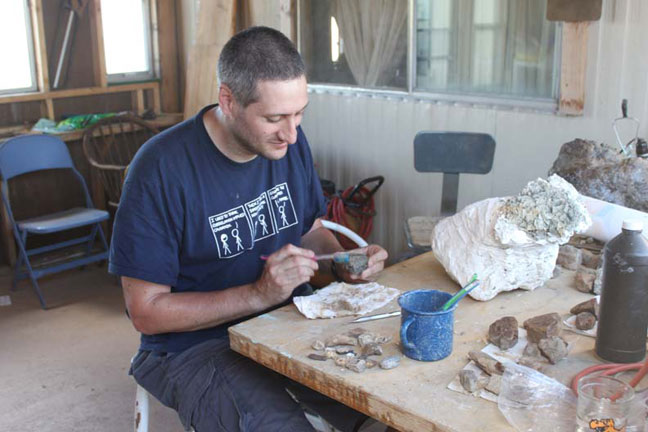
Decades ago I gave myself a goal of becoming a professional paleontologist without getting a degree in it. I didn’t want to become a professional through credentials, but through “feats” (to use a term from comic battle debating, which we’ll get to below). Paleontology is one of the few sciences that accepts contributions from amateurs. Could I, on my own, gain the respect of other, “actual,” paleontologists? How? When? Eventually I started focusing on what I called Dinosaur Aesthetics, or why we think dinosaurs look the way we think they do. I started doing talks at science conferences and exhibitions in educational and science venues. I didn’t become a “normal” paleontologist, but what I had to say did garner support among paleontologists (and non-paleontologists).
In more recent years I’ve similarly jumped into the pool of comic fandom. My goal isn’t to become an expert ON fandom, but an expert AT fandom. An expert in the art of being a fan—because I see fandom as an active art form.** The artistry of some forms of fandom is obvious: fan art, fan fiction, fan videos, cosplay. But I think the whole thing is an art form. It’s a creative, generative conversation that continually leads to new forms of production. Sometimes that’s “just” conversation, which again from my performative background feels very much like art anyway. But those conversations, in my experience, keep finding their way towards specific forms of communal and creative conversations: wiki-writing, comic battle debating (which is basically like art historical close reading, but used to decide whether a comic character can beat up another comic character), and so on. I get a little worried about the way the world of galleries and museums is often tied to corporations, billionaires, and commercialism. I think grassroots forms of sharing artistic impulses, like fandom or zines or meme culture, offer some of the best hope for the arts’ ability to stay tied to individual people, to stay democratic with a small “d.”***
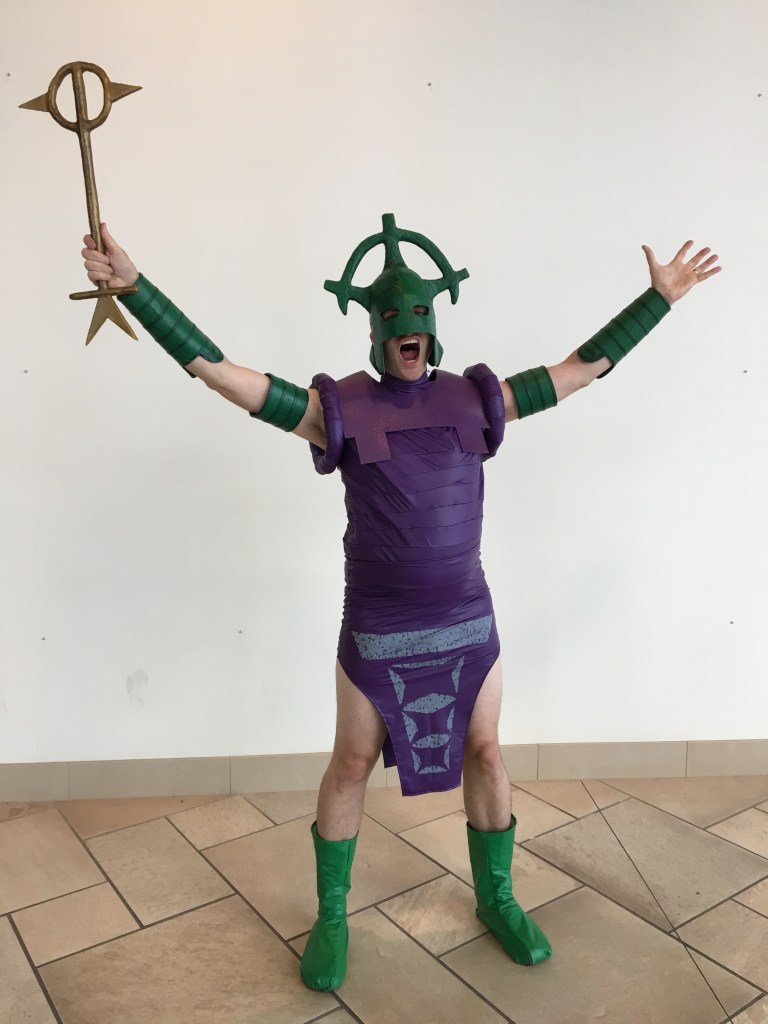
So that’s where the cosplay comes in, and comic battle debating, and the comic con I run, and the letters I write to comics, and that sort of thing. Along the way I’ve gained various accolades from within fandom, as you’ll see under each project.
All of this work that interrogates the concept of peer review falls under a project called Loki. It’s a trickster perspective, but for me, while tricksters are anti-authoritarian—a necessary spirit for these times—they also attempt to find the “real” truth that underlies the community values that may have become institutionalized. We root for tricksters like Loki, Coyote, or Sun Wukong because we identify with them over the authority figures they oppose, even if the authority figures sometimes seem to represent “normalcy” in culture. Tricksters try to show that things don’t have to be the way they are. They subvert authority in order to show that there is a humanity underneath formalized society that is worth saving. Artists are anarchists, I think, in that we give our loyalty to the belief that art helps to generate humanity through individual creative choices.
So, in my recent work, instead of building peer review through an association with certain galleries or grants or journals, I’ve put together a network of cosplay awards, battle debating accolades, wiki-writing rankings, and caches of published fan letters. That is my way of embracing the generosity, the community, and the anarchy of art.
I hope this work shows that creative growth and even expertise is accessible to all. The expectations and definitions for creative excellence are created by our creative communities, and I believe in the potential and value for creative activity in everyone. Communities are made out of individual people who make stuff and do stuff. Which is to say, people who engage in creative production. Help build your own creative community through your own creative contributions. That has value, and is worth recognizing. You are worth recognizing.
*I’m not claiming this is the “only” or “correct” definition of conceptual art. Lots of great conceptual artists have other definitions and they make sense for their work. This is the one that I like for myself.
**This is not just me, there’s a whole field of fandom studies and it widely embraces a concept of active fandom through the work of people like Henry Jenkins.
***You might well point out that fandom is birthed from vastly commercial enterprises like movie and comic corporations. That’s certainly true, but the fans themselves tend to be motivated more by glory among other fans than by making money. What I like is that among “amateurs” like fans, or amateur paleontologists or astronomers, or practitioners of many “women’s crafts” like quilting or knitting, or zine makers, or meme makers, there are still clearly forms of peer review and ways to prove expertise—they’re just democratic and extricated from institutionalized forms of power.

