Tiboro Cosplay

This is my most recent cosplay, of Tiboro, LORD OF THE SIXTH DIMENSION!!!!!!!  (You know, two dimensions over from Time, right?). He’s a minor villain for Dr. Strange. I created it to go along with my family’s group cosplay, which was themed as “Extra-dimensional Lords”! (My wife was Hela, my daughter was Clea, and my son was Annihilus.) We wore them at New York Comic Con.

I’ve revised it since then: a completely different wand, modified helmet, new chest/shoulder armor, new texture and paint, and a modified boot.  I’m much happier with this version.

The first image is a cold-weather version with some black spandex that’s not part of the official costume; the second image is the original iteration; the others are the new version.


Round Robin FanFic and Comic Battle Debate

I was invited to CannonCon, a comic convention in Watertown, NY.  There, I gave a talk called The Social Side of Geek Culture where I compared geek fandom to social sculpture.

I also did two interactive projects at the end, a Round Robin FanFic and a Comic Battle Debate.

For the Round Robin FanFic, the members of the audience and I took turns, each writing a sentence in a piece of fan fiction.  I then posted it on Comic Vine, for others to read and comment, if they like.

For the Comic Battle Debate, I led the audience in a debate about a battle between Spider-man and Batman, where we parsed their respective strengths and weaknesses, and argued our individual positions on the fight.

Both projects went over well with an enthusiastic audience, for whom I was very appreciative.

You Don’t Rob Me, I Don’t Rob You.*

*Also applies as follows: You don’t murder me, I don’t murder you; you don’t rape me, I don’t rape you; you don’t hit me, I don’t hit you; you don’t lie to me, I don’t lie to you; you don’t lie about me, I don’t lie about you; you don’t insult me, I don’t insult you; you don’t cheat me, I don’t cheat you; you don’t break my trust, I don’t break your trust; you don’t put me down, I don’t put you down; you don’t ignore me, I don’t ignore you; you don’t disrespect what I say, I don’t disrespect what you say; you don’t restrain me, I don’t restrain you; you don’t harm me, I don’t harm you; you don’t treat me poorly, I don’t treat you poorly;  you treat me like a human being, I treat you like a human being.**

**Other conditions may be added at any time.

Performance.  Soft opening: January 1, 2017.  Grand opening: January 20, 2017.

The Art of Comic Battle Debating

In November, I gave a talk at the Society for Science, Literature, and the Arts (SLSA) conference in Atlanta, for the Narration and Authorship 2 panel, chaired by Aleksandra Hernandez.

My talk was about the art form of comic book battle debating, and built off my Owie project that I have been doing on Comic Vine for a few years now, as well as a talk I gave at the Paradox conference in Poznan, Poland last year, which was on the art form of performative fandom in general, from wiki-writing to fan fiction to cosplay to battles.

Basically I see these performative fan activities as worthwhile objects of study as legitimate artforms on their own, and of value equal to the artforms that inspired them, such as comics, movies, and video games.

I am also writing an essay on the subject for the Polish journal Czas Kultury, which I think will be out some time in 2017.

I keep wanting to do an actual battle debate with the audience, but unfortunately time constraints have kept that from being practical so far.  Hopefully some time in the future I’ll be able to do that as a performance, either at a conference or in a more direct performance setting.

(Also, I should note that while I haven’t been posting in a while, I have a lot of projects going on.  They’re just ongoing projects that I’ve been working on continuously for years and don’t really wrap up for a presentation or exhibition somewhere.  They’re just going on in their native contexts, as Owie does on Comic Vine.)

Back Issues

I’ve been volunteering at Cloud City Comics & Toys since February 2012.

I help organize their boxes of back-issue comics, putting them in alphabetic and numeric order. I keep general tabs on the 60+ boxes of old comics in the front of the store, which are generally in order but can become slowly disorganized through their constant use by customers.

outside boxes

My main priority, however, is organizing the boxes in the store room in the back, where Cloud City puts the comics they buy from other collectors, and which eventually end up for sale online. Since they are constantly buying collections, this is an endless task! The comics in these back-room boxes are often completely random, so they must be organized from scratch.  Here’s a small sample:

backboxes

Originally, I just organized these boxes individually.  I am now engaged in a new “Uber Organization,” which is slowly creating an inter-box order, with the first box starting with the A comics and moving along to the last box ending with all the Z comics.  There are scores of boxes to be organized and interpolated.

A standard comics long box holds about 200-300 comics. I can organize one to three individual boxes an hour, depending on how well they’re organized in the first place.  With the new Uber-Organization, I can do about one box every two hours.

I work on Back Issues depending on need.  Originally I worked there about two hours a week.  After I finished organizing all the boxes in the front and back, I took a break for a few months until there was more organizing to do.  I am now back to working on the Uber-Organization every week.

A lot of my work is about systems organization, and often I deal with very complex systems, as seen in my paleontology projects (some of which can be seen on this site), tree projects, or In Medias Res. Back Issues, on the other hand, intentionally deals with a very straightforward kind of organization (alphabetic and numeric), but also one that has a direct, positive, real-world impact on the store in which I volunteer: putting the comics in order improves the customer experience in the front of the store, and allows Cloud City to more easily put their back-room comics up for sale online.  Since a lot of my work also involves me trying to help people for free (although I do get a discount on my comics, so not entirely free in this case!), this “helpful volunteerism” is also an important aspect of the work.

I want to thank Jeff Watkins, the owner of Cloud City, for generously allowing me to work with the store on this project.

Owie

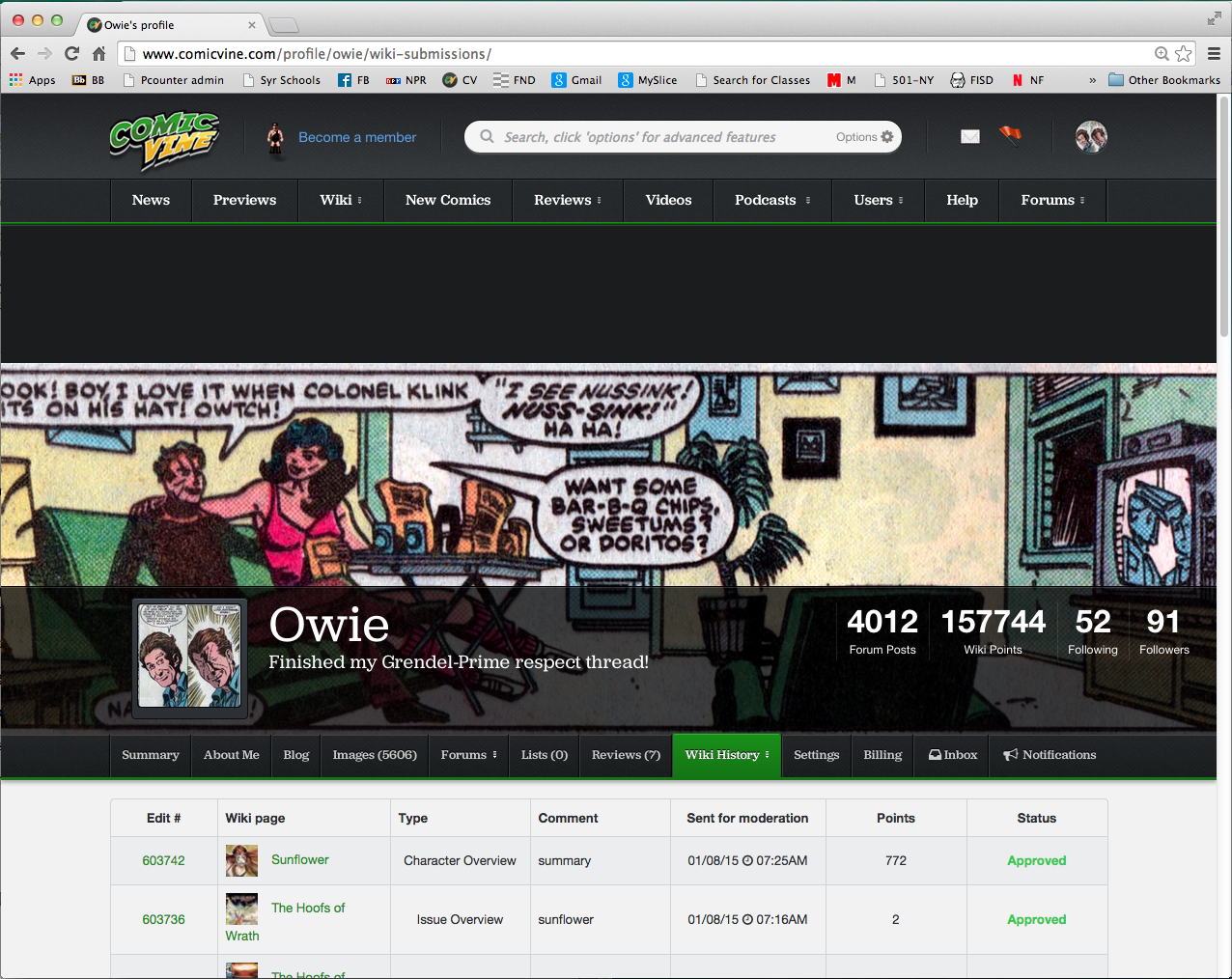
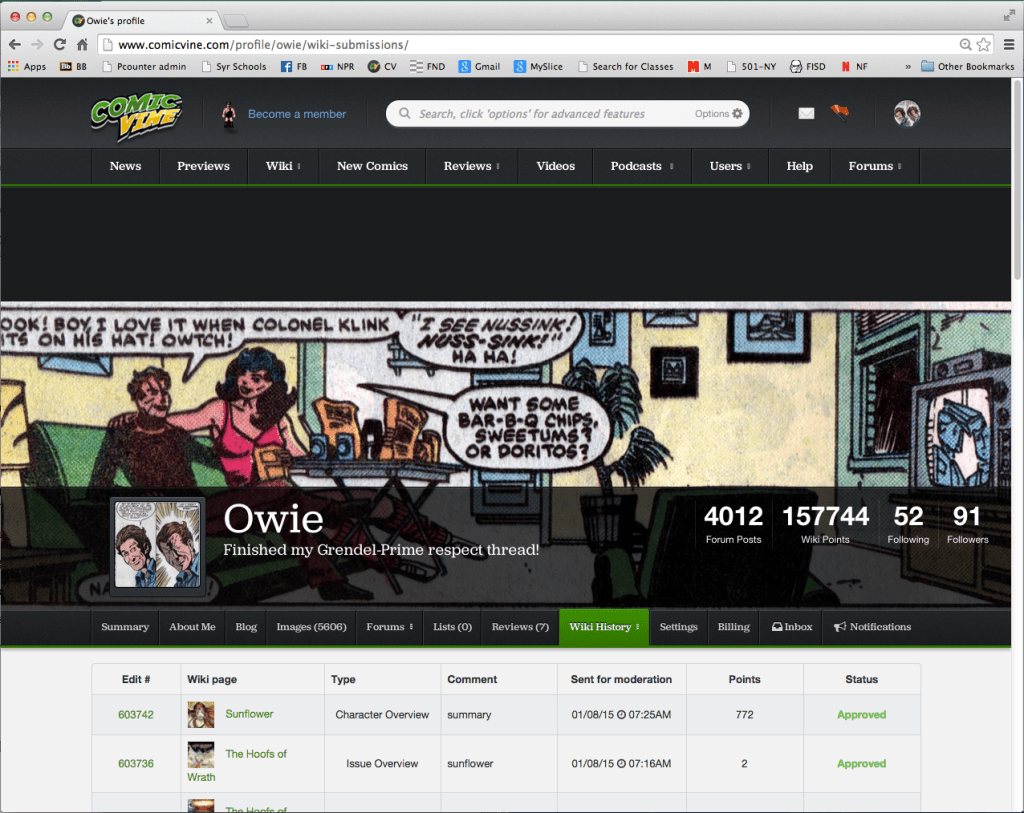
For several years, I have been a member of the comic book site, Comic Vine, which is the largest comic wiki in the world and also hosts a variety of discussion forums. “Owie” is my username on the site.
Screen Shot 2015-01-10 at 8.03.15 PM

I don’t do anything different from anyone else on the site. Comic Vine contains hundreds of thousands of wiki entries, including descriptions of individual issues, characters, and their creators. It is entirely written by comics fans worldwide, who volunteer their time out of a pure love for the medium. These wiki sections have strict guidelines, are written in intricate detail, and are aimed at creating a professional-style encyclopedia on comics. The site also has many forums. Contrary to the stereotype of online conversations, Comic Vine discussions are often highly intellectual and thoughtful, and there are large sections in which the users practice very evolved versions of debate and in-depth logical analysis.

Owie, as an art project, exists solely to highlight this kind of activity as a worthwhile form of creative production. In essence, I think the everyday users’ activities on this site are an enjoyable form of creative production that contributes to our overall culture in a way that is just as legitimate as traditional forms of cultural production (the “arts”), such as visual art, theater criticism, advertising, crochet, etc.

Of course, Owie doesn’t only exist as an art project; it’s also an honest expression of my interest as a sincere comics fan!  It has been my goal to find ways to contribute to the site and become a useful and respected member.  I think I’ve done a pretty good job at this and have been noted for my efforts in a variety of ways.  I was nominated for the Debator Hall of Fame by other users (although I have not been voted in as a finalist); my posts have been selected by the staff for one of the Arguments of the Week for the Battle of the Week nine times, which is one of the most, if not the most, of any participants; I was an invited judge in a tournament; and I am approximately the 50th-highest wiki-writer on the wiki out of about 200,000 members, with 157,000+ wiki points. I have created over 250 battles on the site, which puts me among the most prolific battle creators, and I originated a particular kind of bracket battle that has been used by multiple other users. The threads that I created in 2014 alone brought in over 15,000 page views, with several individual threads having comparable numbers of views to staff articles.

All together, Owie is one of my main projects and is an attempt to dig into the ways that normal people contribute to creative culture outside the art world.

Here are the links to the Battles of the Week that my arguments were featured in.  Scroll down until you see “Owie” in each article.

Black Widow vs Talon. I argued for Black Widow, Talon won the user poll.

Batman vs Snake-Eyes. I argued for Too Close to Call, Batman won the poll.

Moon Knight vs Batwoman.  I argued for Moon Knight, and he won the poll.

Cyclops vs Ninjak.  I argued for Too Close to Call, Cyclops won  the poll.

Green Arrow vs Black Widow. I argued for Green Arrow, and he won the poll.

Green Arrow vs Elektra.  I argued for Elektra, Green Arrow won the poll.

Wonder Woman vs Beta Ray Bill.  I argued for Too Close to Call, Wonder Woman won the poll

Raphael vs Damian Wayne. I argued for Raphael, and he won the poll.

Aquaman vs She-Hulk.  I argued for Aquaman, and he won the poll.

Satellite Store/Comics Lending Library

I’ve done two projects where I am trying to spread an appreciation of comics to everyday people. They were both inspired by my work organizing the back issues at Cloud City Comics.

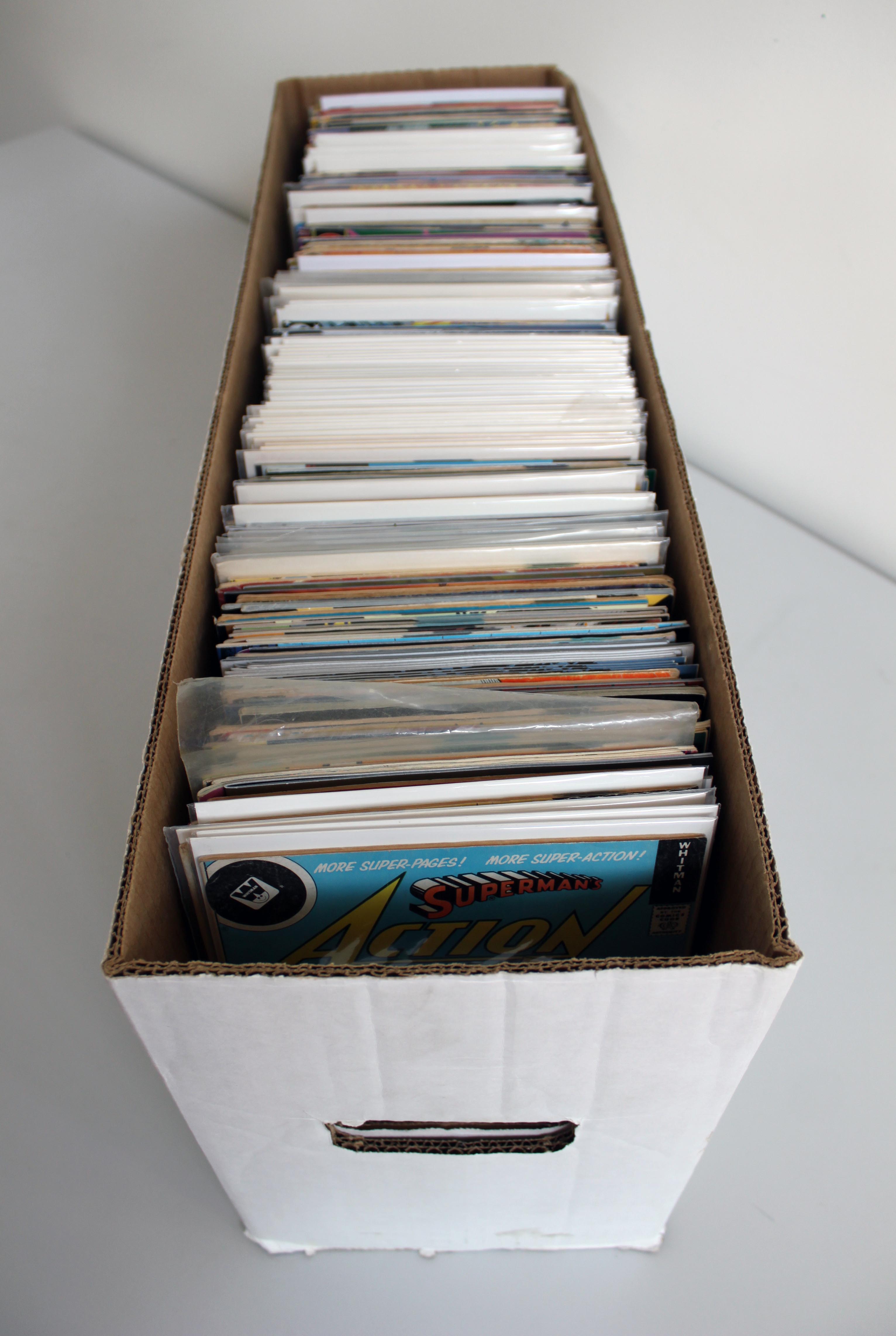
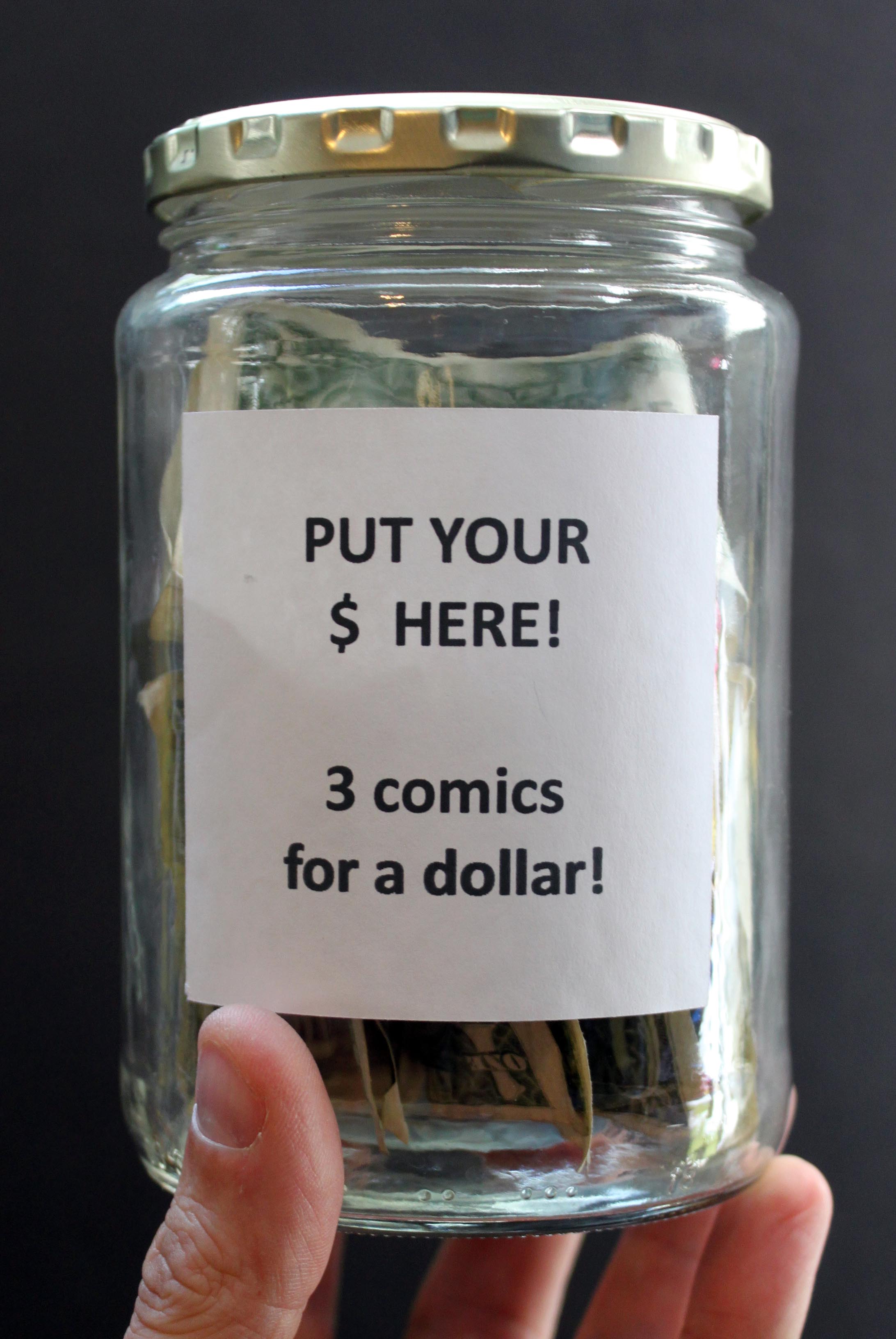
For the fist project, Satellite Store, I borrowed a box of comics from Cloud City, with their permission.  The comics were all random old, unpriced back issues that had not yet been sorted into Cloud City’s various sales sites.  We took out all the really rare and expensive ones, but there were still plenty of pretty good issues in there.  I put them in a gallery exhibition and put them up for sale for 3 comics for a dollar–much cheaper than they would be in a store.  The goal was to see if standard gallery viewers would check out some comics if they were sold for rock-bottom prices. I sold 39 comics over the length of the show, making $13.  I split the money evenly with Cloud City.

Here’s the box of comics:

back issues

And the money! People were on the honor system to pay up, and everyone did.

money

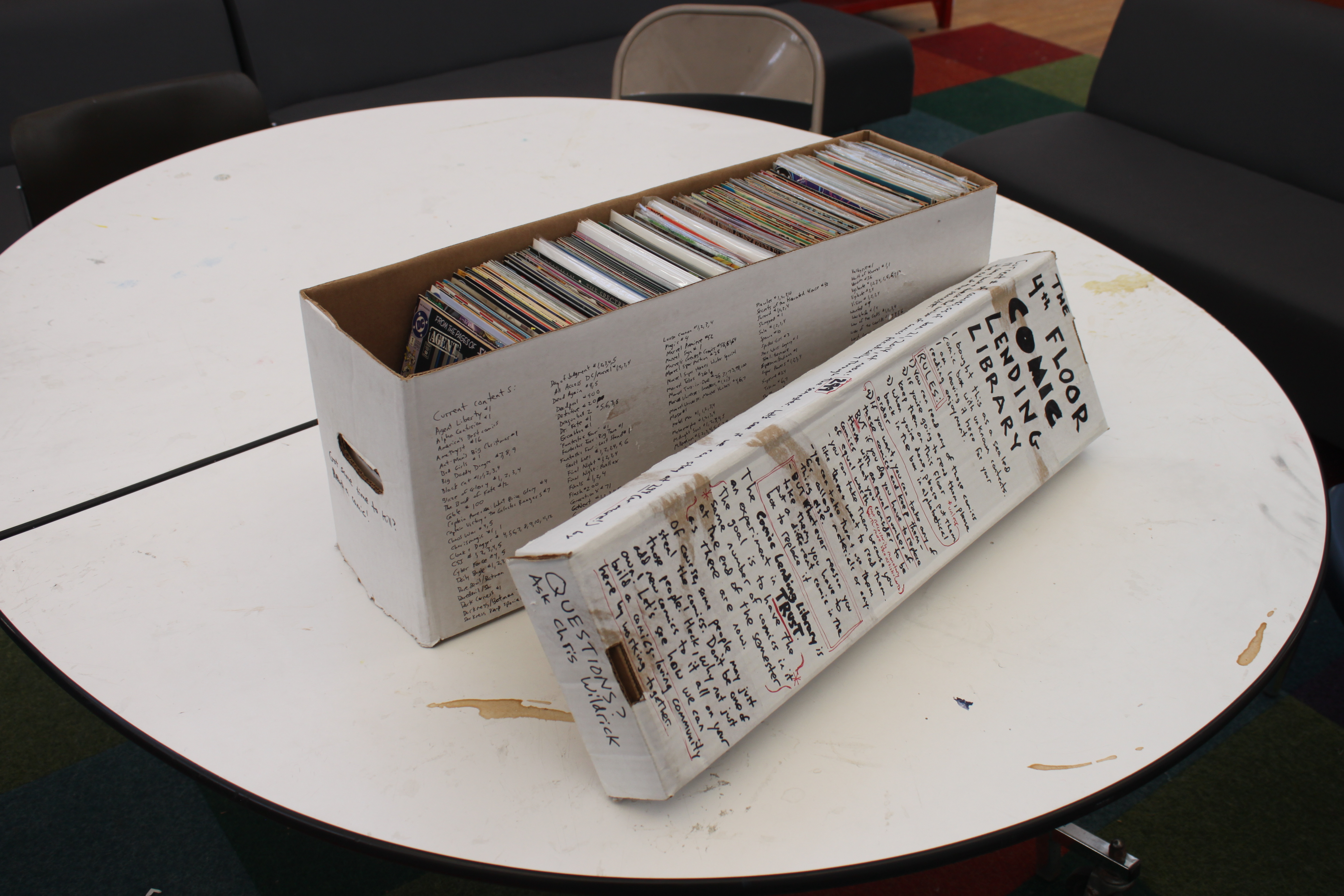
For the next version, I created a Comic Lending Library in the lounge area in my department’s building, where students often relax between classes.

Here, the comics were not for sale, but were available for everyone to read.  In this case, I bought the box from Cloud City when they had a sale of complete boxes that were sealed so you wouldn’t know what was inside.  Once again, they were random old comics with some very cool issues inside.  I left the box in the lounge, with instructions that people could read anything they wanted inside. They were also allowed to take them out and keep them, but if they did, they would have to put a new comic own their own in, to replace it.  All the comics in the box are listed on the side.  As old ones are taken out, they are crossed off, and as new ones are put in, they are added to the list.

IMG_3151

This is partly an experiment in trust and the upkeep of the commons.  If something is free, will people take care of it?  I check it every semester: in the first semester, 29 comics were taken out with no replacements.  This was something of a failure, although not unexpected.  I was honestly happy that no one stole the entire box, as it would have been easy to do so.  On the positive side, people had clearly gone through and read lots of the comics, and in that sense it was quite a success.  In the two semesters since then, only 7 comics total have been taken, which I think is because the rules of the library have become better known and respected.  I have occasionally replenished the box with new comics as others are taken out.  It continues to be used, and the comics read, quite often.