Back Issues

I’ve been volunteering at Cloud City Comics & Toys since February 2012.

I help organize their boxes of back-issue comics, putting them in alphabetic and numeric order. I keep general tabs on the 60+ boxes of old comics in the front of the store, which are generally in order but can become slowly disorganized through their constant use by customers.

outside boxes

My main priority, however, is organizing the boxes in the store room in the back, where Cloud City puts the comics they buy from other collectors, and which eventually end up for sale online. Since they are constantly buying collections, this is an endless task! The comics in these back-room boxes are often completely random, so they must be organized from scratch.  Here’s a small sample:

backboxes

Originally, I just organized these boxes individually.  I am now engaged in a new “Uber Organization,” which is slowly creating an inter-box order, with the first box starting with the A comics and moving along to the last box ending with all the Z comics.  There are scores of boxes to be organized and interpolated.

A standard comics long box holds about 200-300 comics. I can organize one to three individual boxes an hour, depending on how well they’re organized in the first place.  With the new Uber-Organization, I can do about one box every two hours.

I work on Back Issues depending on need.  Originally I worked there about two hours a week.  After I finished organizing all the boxes in the front and back, I took a break for a few months until there was more organizing to do.  I am now back to working on the Uber-Organization every week.

A lot of my work is about systems organization, and often I deal with very complex systems, as seen in my paleontology projects (some of which can be seen on this site), tree projects, or In Medias Res. Back Issues, on the other hand, intentionally deals with a very straightforward kind of organization (alphabetic and numeric), but also one that has a direct, positive, real-world impact on the store in which I volunteer: putting the comics in order improves the customer experience in the front of the store, and allows Cloud City to more easily put their back-room comics up for sale online.  Since a lot of my work also involves me trying to help people for free (although I do get a discount on my comics, so not entirely free in this case!), this “helpful volunteerism” is also an important aspect of the work.

I want to thank Jeff Watkins, the owner of Cloud City, for generously allowing me to work with the store on this project.
Owie

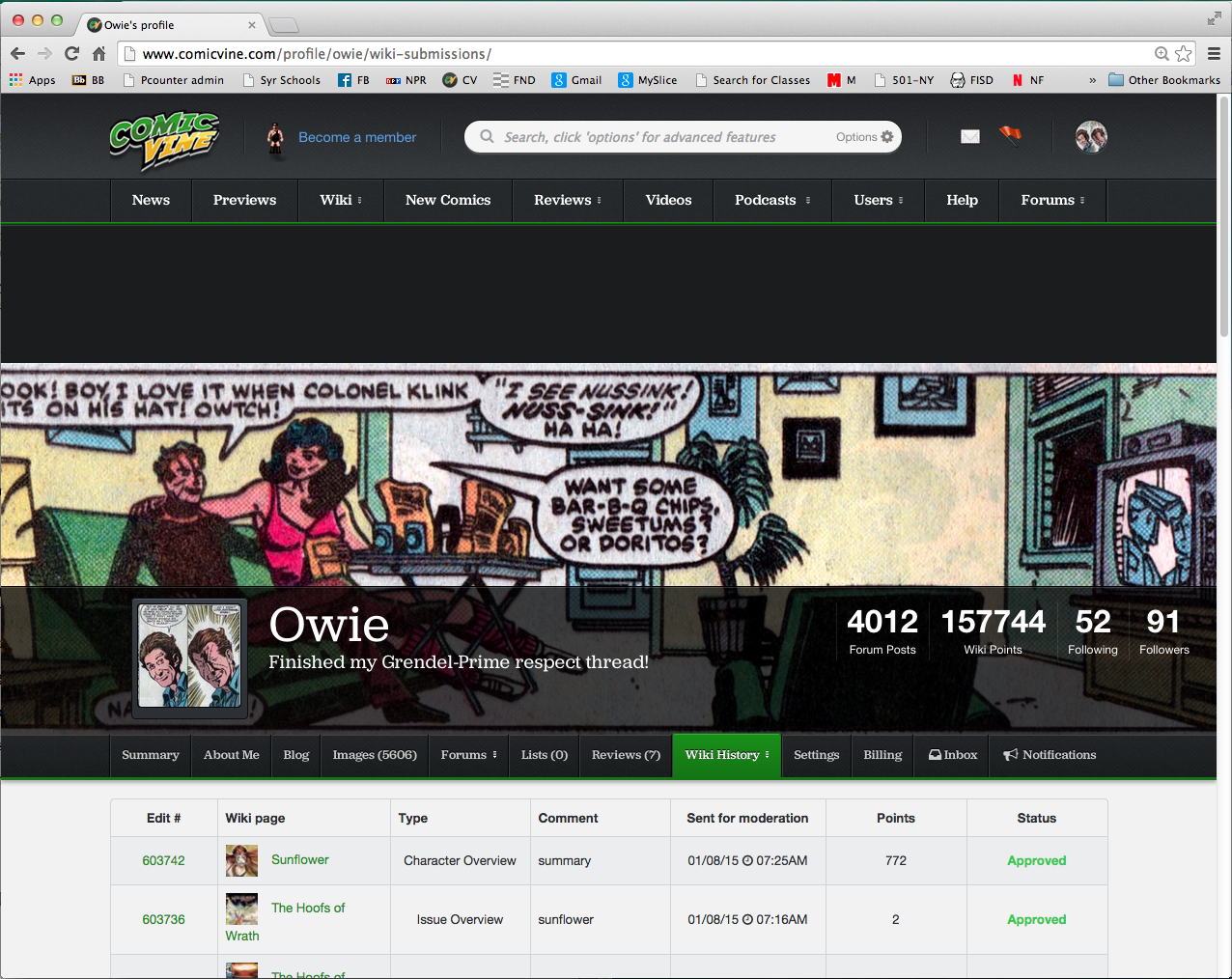
For several years, I have been a member of the comic book site, Comic Vine, which is the largest comic wiki in the world and also hosts a variety of discussion forums. “Owie” is my username on the site.

Screen Shot 2015-01-10 at 8.03.15 PM

I don’t do anything different from anyone else on the site. Comic Vine contains hundreds of thousands of wiki entries, including descriptions of individual issues, characters, and their creators. It is entirely written by comics fans worldwide, who volunteer their time out of a pure love for the medium. These wiki sections have strict guidelines, are written in intricate detail, and are aimed at creating a professional-style encyclopedia on comics. The site also has many forums. Contrary to the stereotype of online conversations, Comic Vine discussions are often highly intellectual and thoughtful, and there are large sections in which the users practice very evolved versions of debate and in-depth logical analysis.

Owie, as an art project, exists solely to highlight this kind of activity as a worthwhile form of creative production. In essence, I think the everyday users’ activities on this site are an enjoyable form of creative production that contributes to our overall culture in a way that is just as legitimate as traditional forms of cultural production (the “arts”), such as visual art, theater criticism, advertising, crochet, etc.

Of course, Owie doesn’t only exist as an art project; it’s also an honest expression of my interest as a sincere comics fan!  It has been my goal to find ways to contribute to the site and become a useful and respected member.  I think I’ve done a pretty good job at this and have been noted for my efforts in a variety of ways.  I was nominated for the Debator Hall of Fame by other users (although I have not been voted in as a finalist); my posts have been selected by the staff for one of the Arguments of the Week for the Battle of the Week nine times, which is one of the most, if not the most, of any participants; I was an invited judge in a tournament; and I am approximately the 50th-highest wiki-writer on the wiki out of about 200,000 members, with 157,000+ wiki points. I have created over 250 battles on the site, which puts me among the most prolific battle creators, and I originated a particular kind of bracket battle that has been used by multiple other users. The threads that I created in 2014 alone brought in over 15,000 page views, with several individual threads having comparable numbers of views to staff articles.

All together, Owie is one of my main projects and is an attempt to dig into the ways that normal people contribute to creative culture outside the art world.

Here are the links to the Battles of the Week that my arguments were featured in.  Scroll down until you see “Owie” in each article.

Black Widow vs Talon. I argued for Black Widow, Talon won the user poll.

Batman vs Snake-Eyes. I argued for Too Close to Call, Batman won the poll.

Moon Knight vs Batwoman.  I argued for Moon Knight, and he won the poll.

Cyclops vs Ninjak.  I argued for Too Close to Call, Cyclops won  the poll.

Green Arrow vs Black Widow. I argued for Green Arrow, and he won the poll.

Green Arrow vs Elektra.  I argued for Elektra, Green Arrow won the poll.

Wonder Woman vs Beta Ray Bill.  I argued for Too Close to Call, Wonder Woman won the poll

Raphael vs Damian Wayne. I argued for Raphael, and he won the poll.

Aquaman vs She-Hulk.  I argued for Aquaman, and he won the poll.

Satellite Store/Comics Lending Library

I’ve done two projects where I am trying to spread an appreciation of comics to everyday people. They were both inspired by my work organizing the back issues at Cloud City Comics.

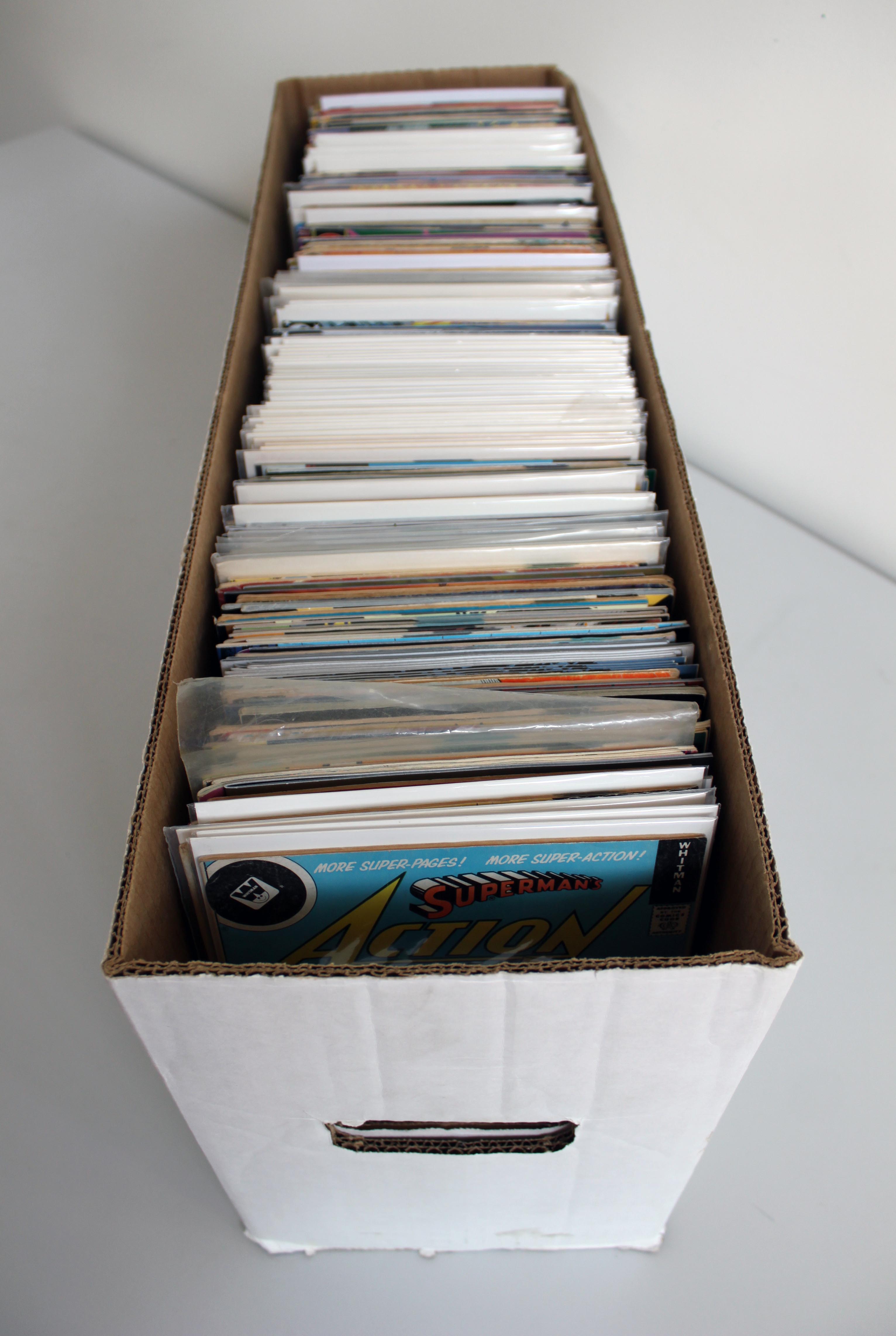
For the fist project, Satellite Store, I borrowed a box of comics from Cloud City, with their permission.  The comics were all random old, unpriced back issues that had not yet been sorted into Cloud City’s various sales sites.  We took out all the really rare and expensive ones, but there were still plenty of pretty good issues in there.  I put them in a gallery exhibition and put them up for sale for 3 comics for a dollar–much cheaper than they would be in a store.  The goal was to see if standard gallery viewers would check out some comics if they were sold for rock-bottom prices. I sold 39 comics over the length of the show, making $13.  I split the money evenly with Cloud City.

Here’s the box of comics:

back issues

And the money! People were on the honor system to pay up, and everyone did.

money

For the next version, I created a Comic Lending Library in the lounge area in my department’s building, where students often relax between classes.

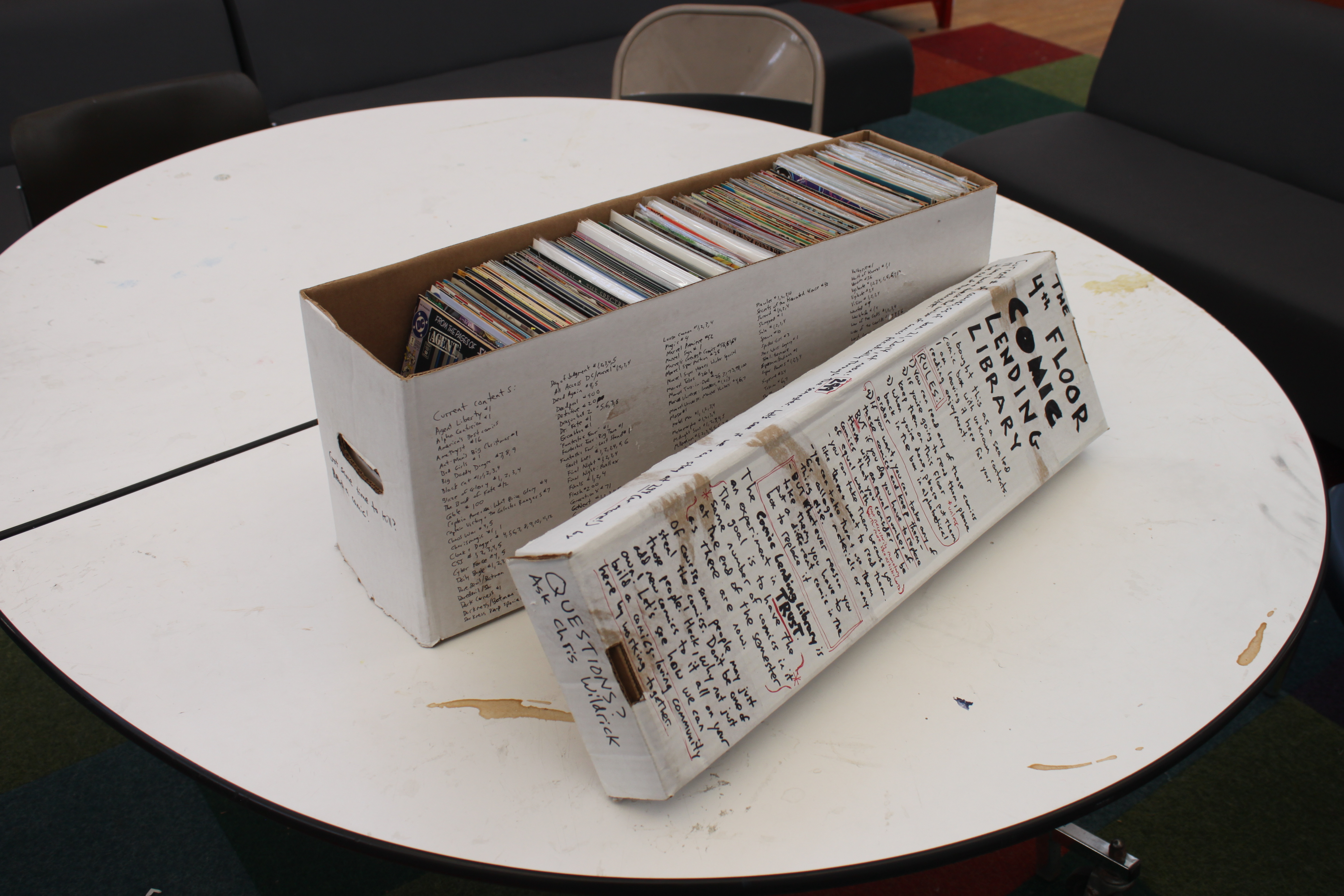
Here, the comics were not for sale, but were available for everyone to read.  In this case, I bought the box from Cloud City when they had a sale of complete boxes that were sealed so you wouldn’t know what was inside.  Once again, they were random old comics with some very cool issues inside.  I left the box in the lounge, with instructions that people could read anything they wanted inside. They were also allowed to take them out and keep them, but if they did, they would have to put a new comic own their own in, to replace it.  All the comics in the box are listed on the side.  As old ones are taken out, they are crossed off, and as new ones are put in, they are added to the list.

IMG_3151

This is partly an experiment in trust and the upkeep of the commons.  If something is free, will people take care of it?  I check it every semester: in the first semester, 29 comics were taken out with no replacements.  This was something of a failure, although not unexpected.  I was honestly happy that no one stole the entire box, as it would have been easy to do so.  On the positive side, people had clearly gone through and read lots of the comics, and in that sense it was quite a success.  In the two semesters since then, only 7 comics total have been taken, which I think is because the rules of the library have become better known and respected.  I have occasionally replenished the box with new comics as others are taken out.  It continues to be used, and the comics read, quite often.

Decades of Divergence in Dino Depiction

Many of my paleontology projects are based on the question of what we think dinosaurs looked like, and why.  We only know about dinosaurs from their fossils, which mostly only show their bones, and are often missing many pieces and are badly deteriorated.  However, when we see pictures of dinosaurs in the media, we see them as fully-realized animals with skin and colors and so on.  How have we gotten to the point where we have come up with such images?

The short answer is that some illustrators work directly with scientists to help flesh out their images, and others do plenty of primary research.  But others just base their drawings on what they’ve seen, and those images quickly become more and more divorced from the science, just like a game of Telephone.  And of course, even the original visual conceptualizations are best guesses, based on those partial fossils.

Not only that, but the science changes over time, with new ideas evolving as new fossils are found!

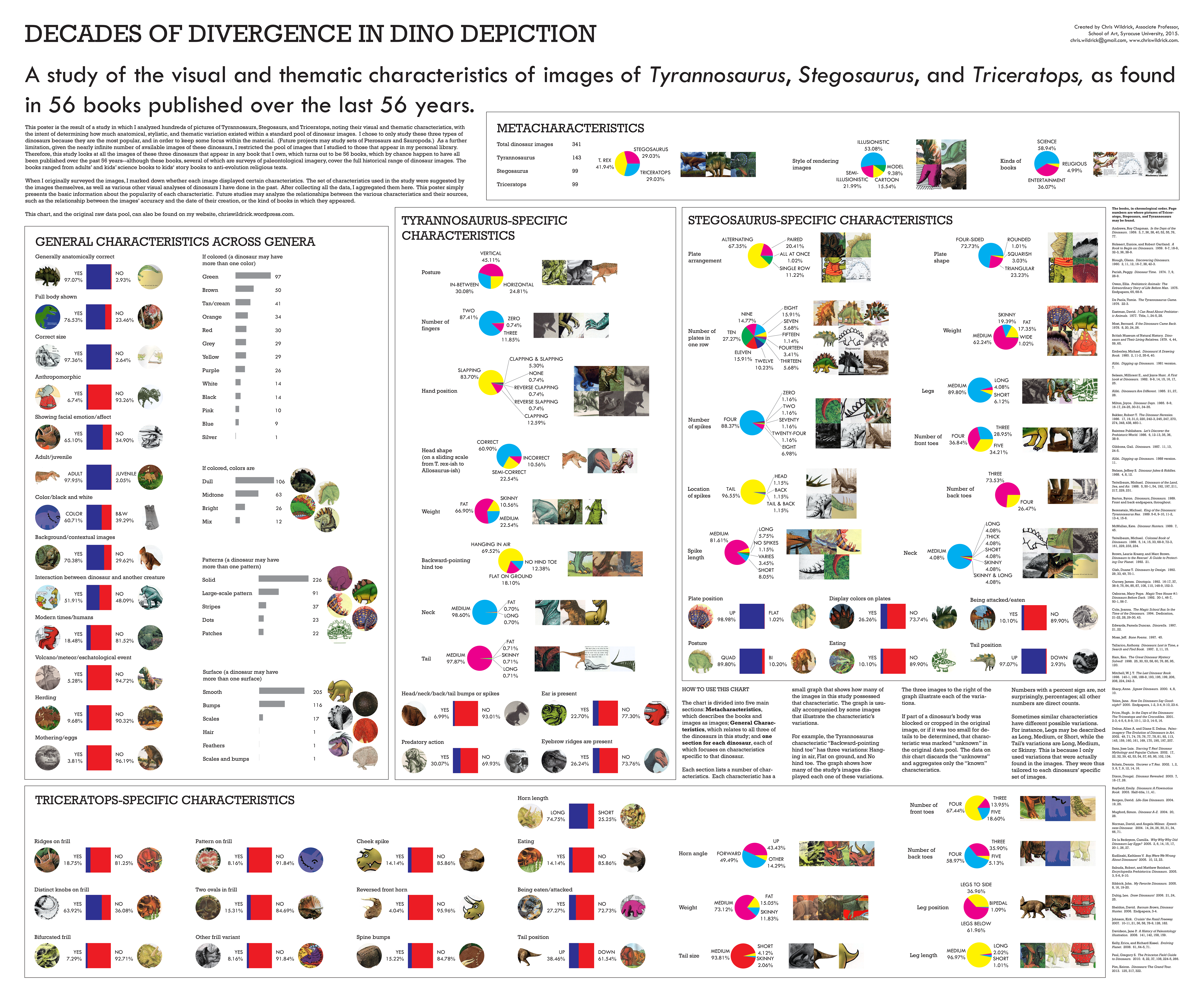
I have often surveyed everyday people about what they think dinosaurs looked like.  In this case, I went to the printed record, and did a morphological analysis of every image of just three dinosaurs–Tyrannosaurus, Triceratops, and Stegosaurus–that can be found among all my paleontology books.  This includes books aimed at all ages, and books that are both entertainment-oriented and scientifically-oriented.

Future versions will do the same for other popular dinosaurs.

This resulted in a huge data pool.  Here is the final analysis, which is in poster form.  It’s been reduced a bit in resolution to fit here but should be fine for these purposes.  Check it out!

decades-of-dinos3

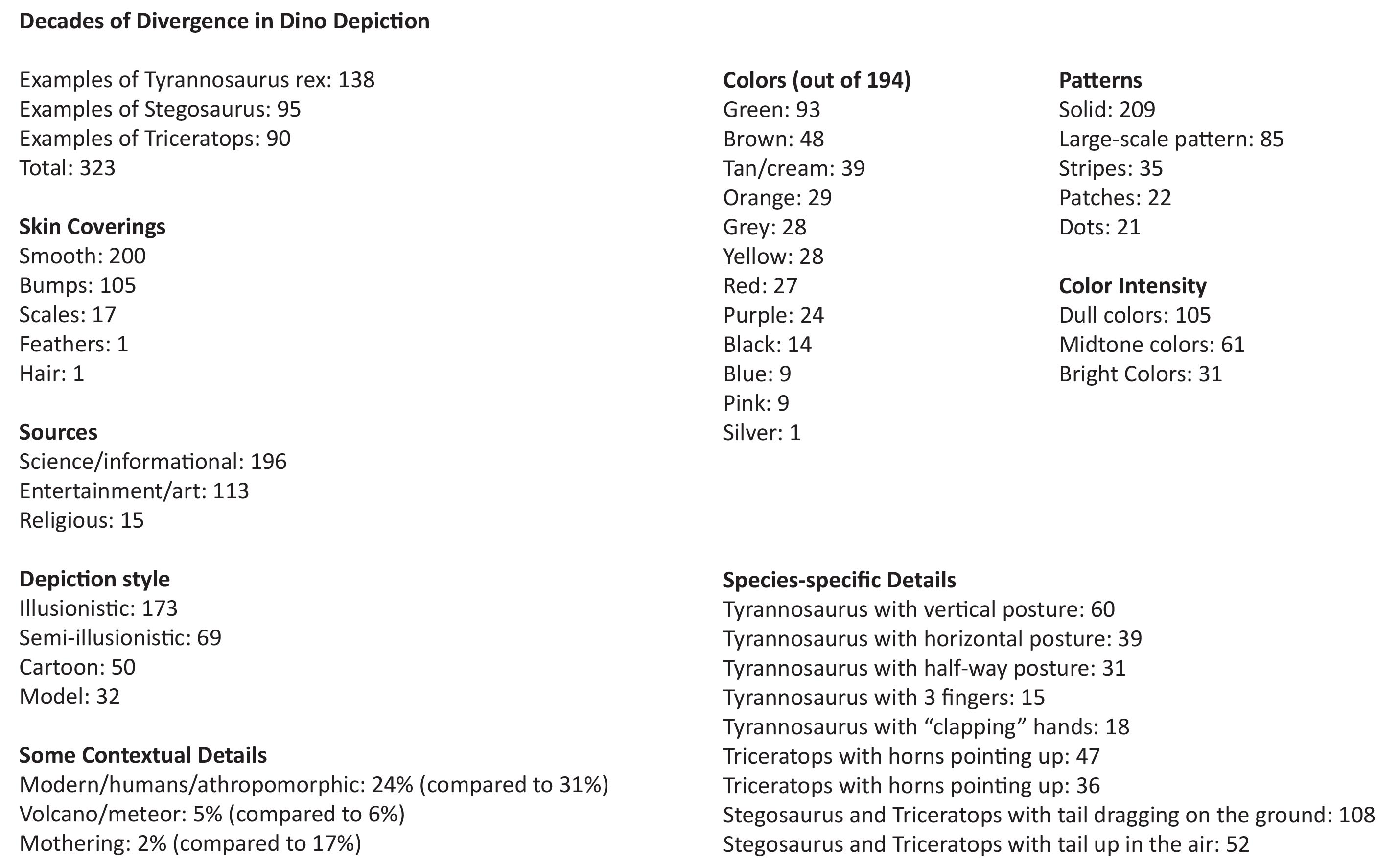
Some of the earlier information, while I was still in the process of analyzing it, can be seen below.

text

Here is the complete data pool, which allows you to see all the characteristics I listed for each image.  I looked both at their visual characteristics (for instance, their color, or the number of plates a Stegosaurus has) as well as their contextual details (for instance, were they shown fighting with another dinosaur, or were they presented in an extinction scenario).

I did an aesthetic-cladistic analysis of the dinosaur images, as I had done earlier for the Clay-dograms, with these sample results.  Each dinosaur (Tyrannosaurus, Triceratops, and Stegosaurus) has two charts, one breaking down the morphology of their images, and the other breaking down their contextual information.

The visual characteristics:

This slideshow requires JavaScript.

The contextual characteristics:

This slideshow requires JavaScript.

Dinosaur Name Pronunciations, I & II

I did two surveys of the pronunciations of dinosaur names.  I have found that people, including paleontologists, often pronounce dinosaur names quite differently, and wanted to find out whether there were any definitive right or wrong ways to say them, or at the very least what trends I would find.  I presented both surveys as posters at a paleontology symposium at the Museum of the Earth in Ithaca, NY.

The first poster surveyed children’s books, because children’s books are where most people first hear dinosaur names pronounced aloud, and are probably where even most adults get most of their pronunciations from.  It is called A Survey of the Variance in Dinosaur Name Pronunciations in Selected Children’s Books.  It looks at 17 books published over a wide time period, and collects 385 pronunciations of 173 dinosaur names.

The second poster surveyed internet sources.  There are several dictionary-style dinosaur websites, each with huge lists of pronunciations, so I thought it would be worthwhile to look at them both in terms of building a giant data set, and because internet sources are likely to become more and more popular as sources for people to check on pronunciations.  They are also probably more adult oriented, and possibly more scientific than the often (but not always) entertainment-oriented children’s books. It is called A Survey of the Variance in Dinosaur Name Pronunciations in Selected Internet Sources.  It analyzes 10 sites and nearly a thousand species, fora total of 2875 different pronunciations. Interestingly, I found two websites that seemed to plagiarize their pronunciations from other sites.

The two surveys came up with some similar results–that there is a lot of variation in pronunciation–but also some differences.  I recommend reading both posters!

Clay-dograms

I did a lengthy interactive project with many people, Skin & Bones II, where people covered plastic dinosaur skeletons in clay in an attempt to make the dinosaurs look like what the people thought the dinosaurs looked like in real life. Then I analyzed the skeletons’ morphology according to over 30 visual characteristics.

For Clay-dograms, I took all the data about the skeletons’ morphology and fed it into Mesquite, a program that paleontologists usually use to create cladograms (sets of evolutionary relationships) based on real fossils’ morphologies. I broke the data down by the species of the original plastic dinosaur, then used the program to find the visual relationships that existed among the clay models.

There is one cladogram per species. The names are shaded from dark to light, depending on how many steps a particular model is from its original “visual ancestor.”  It should be noted that these are not necessarily the only cladistic solutions to the data sets, but are one viable possibility.

This slideshow requires JavaScript.

I performed Skin & Bones II, the project the Clay-dograms are based on, on multiple occasions in Ithaca and Syracuse, NY, including a preschool, multiple elementary school classes from kindergarten to 4th grade, a high school class, and random adults at various sites including the New York State Fair.

Here are a few examples of the 300+ models that people made:

This slideshow requires JavaScript.

Psychic Dinosaurs from the Future

I’m writing a science-fiction novel called Psychic Dinosaurs from the Future.  It’s about some psychic dinosaurs that are from the future.  The book is aimed at middle school kids.

I’m currently editing and expanding the first draft, after which I plan to run it past my kids to see what they think.  When I’ve added what I am sure are their many suggestions for improvements and additions, I’ll start looking for publishers.  Although I consider it to be a work of art–a realization of my explorations into dinosaurs and geek culture–the goal is for it to function as a completely straightforward kids’ sci-fi novel.

I’ve included a couple of the many supplementary materials I’ve created to help write the book: a quick sketch of the various dinosaurs’ colorations and relative scales, and a timeline of which characters appear in each chapter.

Dry Facts, Dry Bones

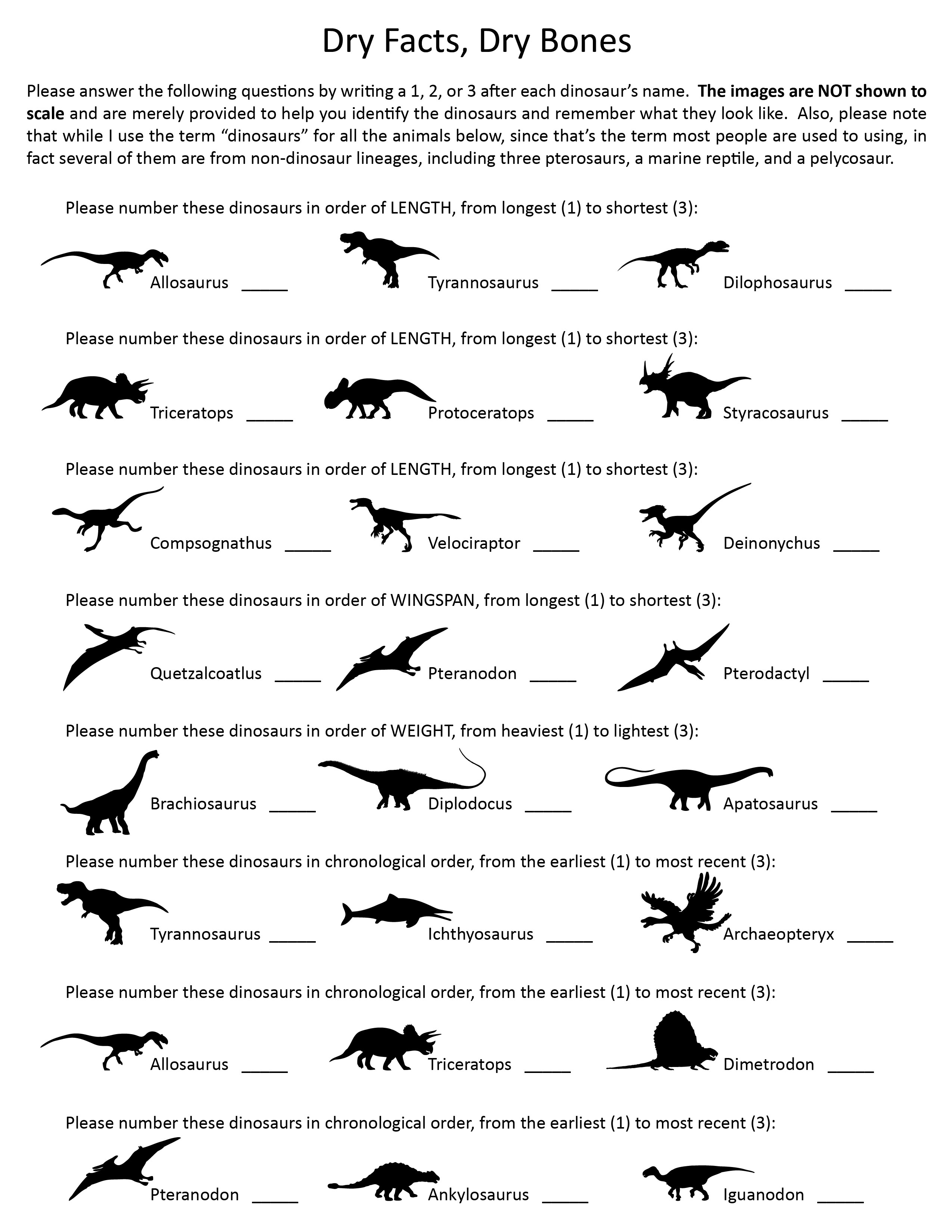
For this interactive project, I wanted to get back to basics and see how familiar everyday people are with some simple dinosaur information, such as their relative sizes and chronological order.

questionnaire-01

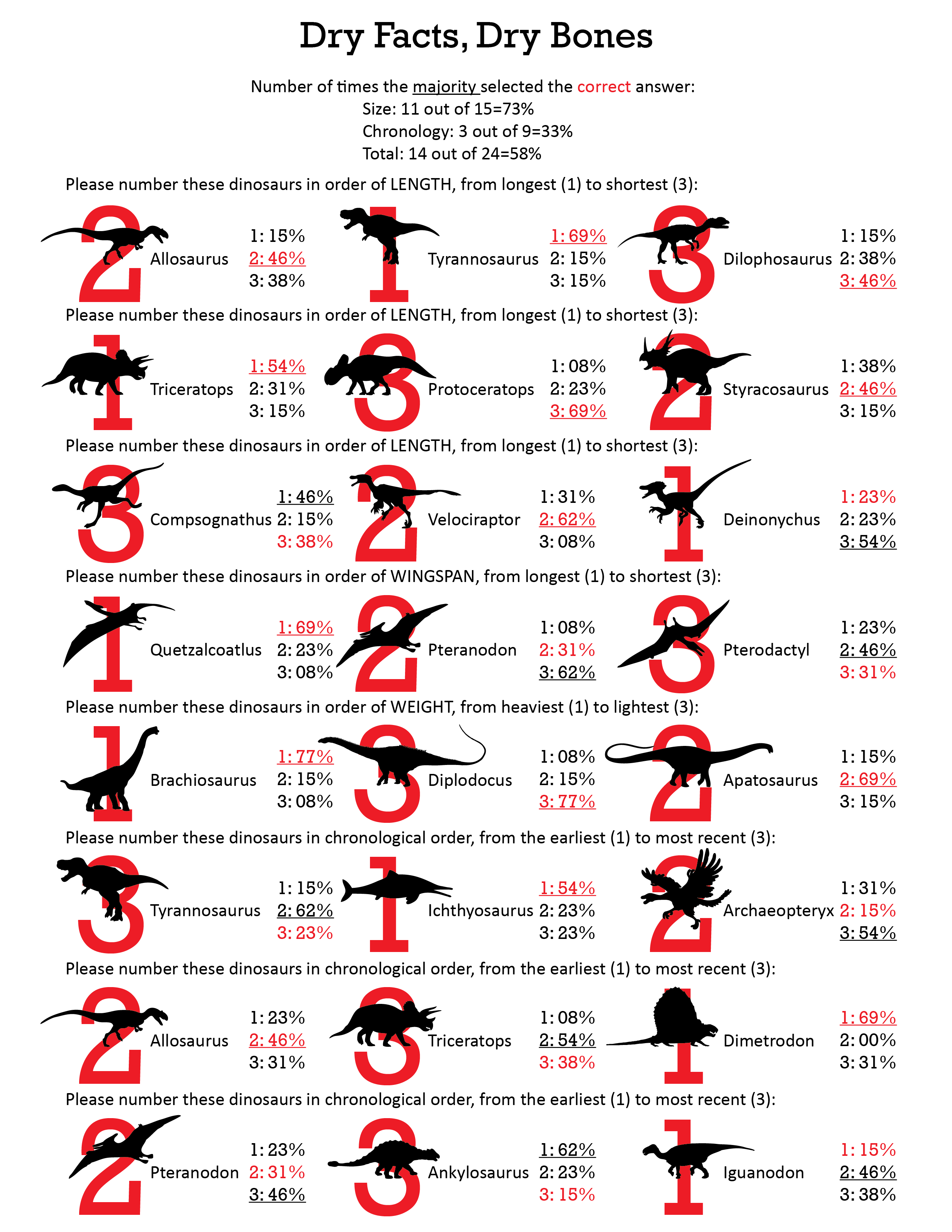
So far, the participants have a 58% accuracy rate. They do much better with size (73% correct) than chronology (20% correct), which is probably not surprising.  Dinosaurs’ appearances in media usually show them in relation to other dinosaurs, so their size is relatively easy to remember, while media are much less scrupulous about showing dinosaurs segregated by their proper time periods. Stegosaurs, for instance, regularly appear with Tyrannosaurs, even though Stegosaurs lived longer ago from Tyrannosaurs than Tyrannosaurs did from us.

questionnaire chart-01

Tooth and Claw

This is a fun, simple participatory game in which you simply choose which dinosaur would win in a fight, for each of fifteen pairs of dinosaurs.  It was inspired by the comic book battles that I enjoy participating in on Comic Vine.

The participating dinosaurs, who are matched up against each other in every possible combination, are Tyrannosaurus, Triceratops, Stegosaurus, Ankylosaurus, Diplodocus, and Velociraptor.

questionnaire-02

The Results!:

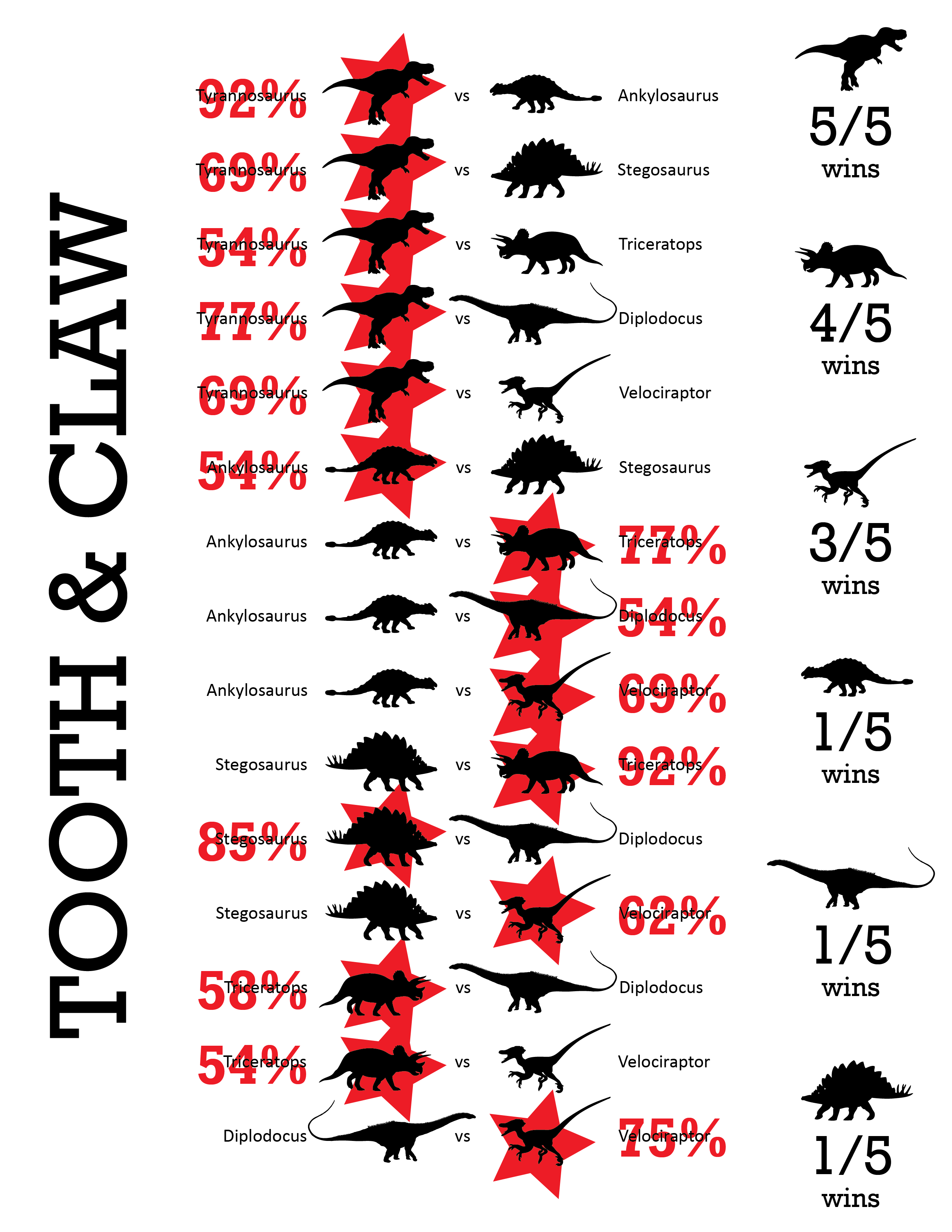
So far, Tyrannosaurus (to no one’s surprise) is the clear winner, with the most total votes among all its battles. The participants forecast it to win all its battles. Triceratops is very close in total votes and is expected to win all its battles except against Tyrannosaurus. Velociraptor comes a little behind them in total votes and wins all its battles except against the former two dinosaurs. The last three dinosaurs are further behind in votes and are all expected to win only one battle each.

The most lopsided battles so far are Tyrannosaurus against Ankylosaurus (92% to 8%) and Triceratops against Stegosaurus (also 92% to 8%). The closest battles are Tyrannosaurus against Triceratops, Ankylosaurus against Stegosaurus, and Triceratops against Velociraptor (all 54/46%).

questionnaire chart-02

Dinosaur Aesthetics Lectures

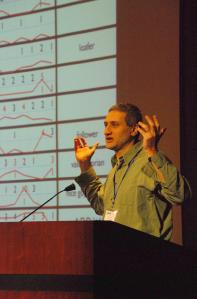
6423226415_6c78896fc0_oI’ve given several talks about my work on dinosaurs at various science and interdisciplinary conferences, including Webwise 2011, organized by the U.S. Institute of Museum and Library Services and held in Baltimore; True Colors, organized and hosted by the Museum of the Earth, featuring Gregory S. Paul as a co-panelist; and Life & Literature, organized by the Biodiversity Heritage Library at the Field Museum in Chicago, and Fluid, organized by the Society for Literature, Science, and the Arts. I also organized my own panel, Dinosaurs on Our Minds, featuring paleontologists from the Museum of the Earth as well as Ryan North of Dinosaur Comics. I have also given these presentations at art and education venues including West Virginia University and Cazenovia College.

These presentations are simultaneously summaries of my dinosaur work in general as well as being performances in and of themselves. They are really a distilled form of my attempt to turn art into a pure conversation between myself and others, similar to other “talking” artworks by artists like Ian Wilson, Tom Marioni, Rirkrit Tiravanija, Joseph Beuys, and Adrian Piper. In a sense, they are the purest version of my dinosaur work.

Photo credit: Life & Literature conference Flickr feed.